Saturday, June 19, 2010

Weird is good.

In my opinion, and for my aesthetic tastes this is very true. Maybe it's my sense of humor (which is a little bit off the wall), but I generally like weird.

The tough thing about "weird" art, though, is that often times it's hard to explain why I like it. However, I read something today in the book I Sold Andy Warhol (too soon) by Richard Polsky -- a fantastic read for any one who is interested in the inner workings of art deals/art-world sketchiness-- that represented one of the reasons why I am inexplicably drawn to abstruse artwork.

The tumbleweed-esque pop art collector Leon Kraushar was once quoted in Life magazine as having said, "Pop art is the art of today and tomorrow and all the future... Renoir? I hate him. Bedroom pictures. It's all the same with Abstract Expressionists, all of them. Decoration. There's no satire; there's no today, there's no fun," (p. 173). While I have to say that I really don't agree with Kraushar on the merits of pop art versus abstract expressionism, I do think he's got a point. There's no harm in having a little fun with the work you produce. Satire is very profound.

Thus, with long intro, I give you Erwin Wurm.

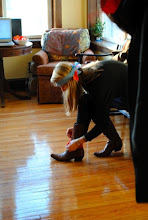
Since the late 1980s Erwin Wurm (Austrian, b. 1954) began his ongoing series called "One Minute Sculptures," in which he poses himself or his models in unexpected and often times uncomfortably hilarious relationships with everyday objects close at hand, helping the viewer to investigate and question what we understand to be sculpture (and for that matter photography and performance). Here are a few of his One Minute Sculptures:


Wurm's One Minute Sculptures don't always involve people. Occasionally, he will use chairs balancing on one leg or with two legs propped up on carrots, a banana suspended between sliding cabinet doors, and upended and stacked configurations of hotel furniture-- all a little bit unusual. But what's really incredible about these is their frequent incorporation of perishable objects, which make the sculptures ephemeral and elusive.

The work that immediately captured my heart was Wurm's Fat Sculptures. I don't know if that's what their officially called, but that's what they are. In a series of mostly life-sized sculptures, Wurm imagines what every day objects would look like in their most obese state (had they the capacity to become that way.

So imagine that you get into your fat car...


and drive to your fat home. Where you will probably sleep on fat pillows with your fat dog in your fat bed.


In many ways, I have a hunch that Wurm draws a lot from Duchamp's why not? kind of attitude. I never felt comfortable approaching this kind of art until I let my guard down, let down my pretensions and joined in saying, "Yeah, okay, why not?" It's funny. It's weird. But it's also wonderful in the ways that it gently prods the viewer by challenging what feels uncomfortable.

For more info, here's a link.

Tuesday, June 1, 2010

ANOTHER blog?

Okay, I know. The amount of blogs on the Internet is absurd. But here's the thing: I've been looking all over the place for a blog about art history-- specifically contemporary art-- that encompasses what's currently happening in the art world and informs me about what lies ahead. Simply put, I have yet to find that blog all ready being written. And that's why this is happening. I was recently encouraged by my brother-in-law to start this blog for myself, even if no one else was reading it. I decided that would be a great idea, if for no other reason than to keep myself informed in a structured way and continue to write about art. Having just graduated with an undergrad degree in Art History, let's just say that I need an outlet.

I have chosen the title of this blog, "Not Vasari," because Giorgio Vasari, a 16th century Tuscan artist-turned-author, was one of the first people to formally write about artists and their work (check out The Lives of the Painters by the man himself if you're interested). I want to use this blog to promote contemporary art (and dig back a little bit if the spirit so moves) by looking at some of our most celebrated and under-appreciated artists of today. It's not Vasari, because we'll hopefully be looking at people Vasari could have never knows about (because he's dead). Vasari was a proponent of the idea of the progression and development of art, so I think that's a great starting place for looking at art. As I examine artists/pieces/movements, I hope that this can really be brought to the forefront of how we see art-- is it really progressing? how is it developing and why?

Given the extremely opinionated personality of your blogger, I fear that I may be no less biased than Vasari was; but I urge you, readers (if there are any) to call me out on it and challenge it. That's how we grow and change and become more well rounded versions of the people we are right now.


Happily, I will welcome contributions to the blog! I've all ready had a friend who's excited about composing something for the blog, and I'm very excited to see what he digs up. I'll try to carry the blog as much as I can, but I'd love support and contribution to everyone who feels so inclined. Also, if you have someone/thing that you want to know more about, let me know, and I'll research it for you, because Lord knows I'd love an excuse to do that.


Oh, and one more thing: let's leave Thomas Kinkade out of this. And Anne Geddes.


So, without further adieu, let's get on to our first artist! I find it only appropriate to look at/ eulogize the work of
Louise Bourgeois, as she left this earth yesterday at the age of 98. Good heavens, she is precious. This photograph was taken with her standing behind her 1970 sculpture Eye-to-Eye. The website for the Centre-Pompidou's exhibition of Bourgeois has this to say as a summary: Born in France in 1911 and residing in New York since 1938, Louise Bourgeois is one of the major artists of the second half of the 20th and early 21st Centuries. Her work, which has traversed Surrealism, Abstract Expressionism and Minimalism, oscillating between abstract geometry and organic reality, escapes all attempts at artistic classification. Based on memory, emotion and the reactivation of childhood souvenirs, Louise Bourgeois follows a subjective approach, using all types of material and all manner of shapes. Her personal and totally autobiographical vocabulary is consistent with the most contemporary of practices, and exerts an influence on many artists. (credit)

Bourgeois's work is bizarrely captivating. Evidently, she has had a life-long fascination with arachnids. While she has worked with spider-imagery since the 1940s, arguably her most celebrated works are her colossal spider sculptures (titled Maman) created in the late 1990s-early 2000. Ultimately, Bourgeois' sculptures incorporate a sense of vulnerability and fragility. Her works are often viewed to have a sense of sexuality to them, which she believed is a large part of both vulnerability and fragility-- undoubtedly themes learned through the childhood experience of her father's adulterous affair with her governess, and event that her mother refused to acknowledge.


Maman at the Guggenheim in Bilbao, Spain

Rest in peace, Louise. The fact that you were the first solo-woman retrospective represented at MoMa speaks very highly of you and your work.