Tuesday, January 18, 2011

Luckily, there are (still) people in Chicago who think that the arts are important enough to sponsor events for the museums (Free Winter Weekdays at AIC!). Also, luckily, I work down the street for the museum. Consequently, I have been spending many of my lunch breaks feasting on the art work there. Today, I aimlessly wandered into the lower level Textile Galleries, as I was internally outraged that I had not yet discovered them. (check out some of the works here)

I felt an instant connection with many of these pieces and their connections to the abstract works of the mid 20th century.

Designed and executed by Ethel Stein
American, born 1917
United States, New York, Croton-on-Hudson
Five Panels, 1982

Honestly, it's like Sol Le Witt
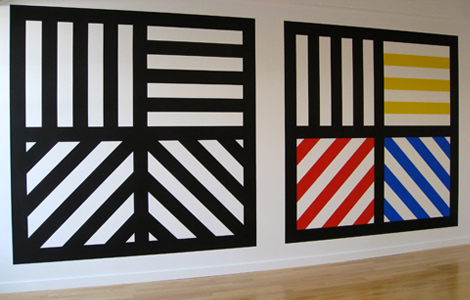
and MC Escher

gave birth to Ethel Stein's work. Although, obviously that didn't happen. It's pretty incredible to look at how she can be a link between the work of two artists I have never considered comparing.

Lenore Tawney is another artist whose work captivated me. Her piece "The Bride has Entered" is almost a proto-Kiki Smith.

Hanging Entitled "The Bride Has Entered", 1982

Cotton, plain weave; painted with pigment and gold leaf; attached linen threads in grid pattern
176.5 x 177.6 x 213.3 cm (69 1/2 x 69 7/8 x 84 in.)

I wish I had a better photograph of this. However, when I saw it down the hallway, it appeared as a jellyfish, suspended in the gallery. As I approached it, it appeared to me almost flesh-like in its color and form, almost menstrual. Yeah, yeah, I took it there. Anyway, Kiki Smith always does a splendid job addressing issues of womanhood with elegance the way that Tawney has in this piece.

I'm really excited to look at the work of Lenore Tawney more, as I learned briefly this afternoon that she's a Chicago artist. Maybe I'll have to start working on a post about her soon!

Finally, I spotted this one across the gallery as well

Hanging Entitled "La Mattinata" (Morning Song), 1975

Linen, plain weave; underlaid with cotton, plain weave; embroidered with linen, silk, and cotton in padded satin, satin and stem stitches; laid work and couching
184.1 x 154.3 cm (72 1/2 x 60 3/4 in.)

Maybe I'm the only person in the world who feels this way, but immediately, I felt that this piece has a strong connection to two other artists I have never before compared. It seems to have referenced a famous painting also housed in the same building...

Mary Cassatt
American, 1844-1926
The Child's Bath, 1893

The composition of the piece by Lissy Funk feels so much like the composition of Cassatt's piece as well. Funk almost has the basin at the bottom of her textile! Additionally, the colors are very similar. However, it's not completely Cassatt, but also a little bit Klimt based on the entwining figures:


... just a thought.

In the mean time, I will keep taking advantage of these free days at the museum for a few more weeks....

Tuesday, January 11, 2011

Fabrics of our lives.


Yes, it's been quite a long break. But, it's hard to keep yourself accountable when life just charges on ahead without asking your permission. Ah, well. I'm back. And with a little determination, this will be more regular-- hopefully a Tuesday night ritual.

Anyone who knows me at all and what I've been up to for the last couple of months will not be surprised by this post at all. Tonight, I bring you a little insight on Batik.

Ba-what? Wait hold on, I thought this was a blog about ART? Well, it's time I let you in on a little secret: I truly believe that textiles are art. Tonight on the way home from work, I finished this book, and I am now more thoroughly convinced that I need to be in this field that I was when I started the book (mind you, it was quite a bit before I began the book). See, visual culture, or visual studies if you will, operates on the assumption that culture is bound by the visual-- be it formal art practices or otherwise. It is essentially more complex that this, but that's the basic gist.

Something that I've been examining for a while now is Batik. Because it is directly related to my present creative endeavors (which, you will hopefully learn about very soon!), I've spent a lot (I mean, a lot) of time looking at Batiks. So here we go!

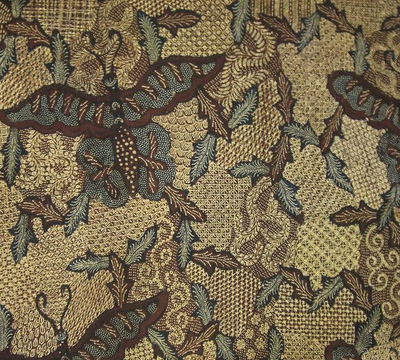
Traditionally using a wax-resist dyeing technique, Batik is a highly developed textile form that originated in traditional Indonesian cultures. For your visual consumption, this is a classic batik:

Great, so you've definitely seen them before if you haven't been living under a rock for most of your life. One of my favorite things is to see the way that many refugees continue to wear them in America. This is one of the only ways you will see them if you live in America. However, they are a very important part of many cultures, which is why I believe it is relevant and good to talk about them at all (in addition to the fact that many of them are just gorgeous).

While Batiks were originally developed in Indonesia, many of my favorites that I have seen come primarily from Ghana and other parts of West Africa.

Good golly, it feels like a forest. In truth, this lovely fabric is hand dyed, carefully constructed with all of those stripes.

Examples of batik textiles can be found throughout Africa, but the most developed skills are found in Ghana and Nigeria where the Yoruba people make adire cloths. There are two interesting methods employed when using the resist technique: adire eleso which involves tied and stitched designs and adire eleko where starch paste is used. Furthermore, the paste is most often made from cassava (a root plant) flour, rice, alum or copper sulphate boiled together to produce a smooth thick paste. The Yoruba of West Africa used cassava paste as a resist while the people of Senegal use rice paste. The paste is applied in two different ways.
  • By using freehand drawing of traditional designs using a feather, thin stick, piece of fine bone or a metal or wooden comb-like tool; usually performed by women.
  • Forced through a thin metal stencil with a flexible metal or wooden tool. This enables accurate repeat patterns to be achieved; usually by men.

What I find to be really fascinating about Batik traditions in Africa is that they are passed down through family lines. Additionally, the patterning, which can be anything ranging from quotidian issues to traditional or tribal history, is passed around through familial lines. In large part, Batik dyeing is a community activity-- this is one of the things I love most. This is generally done, because it is more cost effective, but let's be honest, it's a beautiful thing when humans come to create something in tandem with other humans.

As I mentioned previously, Batik is a huge part of a current project I'm working on, so it's on my mind a lot. Thanks for letting me give you a brief tutorial on batiks, and I'm looking forward to sharing more about my current projects very soon!

(Okay, okay, that last one is a compilation from ApartmentTherapy, but hey, trends! It's great!)